
Last updated October 17, 2026
 Metal roofing
 Tile roofing
 GAF
GAF Owens Corning
 Flat & low-slope
Free roof inspection with deck photos before we talk money - GAF and Owens Corning certified installation
Roofing Warning Signs: A Pasadena Homeowner’s Reference Guide
The most expensive roofing failures in Pasadena don’t start with a leak. They start with granule loss in the gutter, a slightly lifted piece of counter-flashing at the chimney, or a soffit vent that got painted shut. All of these look like non-issues until they’re not. This guide trains your eye on the signals most people walk past for years, the subtle failures hiding in plain sight that cost Pasadena homeowners the most money. For a broader overview, see our Complete Guide to Roofing in Pasadena. By the time you finish reading, you’ll know which warning signs you can photograph and watch, and which ones mean you should pick up the phone this week.
Quick Answer
The roof warning signs that matter most in Pasadena are granule accumulation in gutters and downspouts, lifted or separated flashing at chimneys and wall transitions, attic staining that indicates repeated moisture cycling, and compressed insulation caused by ventilation failure. If you see granule buildup exceeding a quarter cup per downspout splash block after a dry month, or any flashing that has pulled away from its sealant, schedule a professional inspection. Most Pasadena roof failures give 12 to 24 months of visible warning before water enters the living space.
Styles & brands we work with
Table of Contents
- Granule Loss: The Countdown Clock in Your Gutters
- Flashing Failure: Where Pasadena Tile Roofs Actually Fail
- Interior Warning Signs Most Homeowners Misdiagnose
- Roof-to-Wall Transitions on Spanish Colonial and Craftsman Homes
- Ventilation Failure: The Painted-Shut Soffit Problem
- Monitor This vs. Call This Week: A Prioritization Framework
- How Pasadena’s Climate Accelerates Roof Aging
Granule Loss: The Countdown Clock in Your Gutters
Asphalt shingles shed granules from the day they’re installed. That’s normal. What’s not normal is the rate. In Pasadena, where summer roof surfaces routinely hit 140 to 160 degrees Fahrenheit and UV exposure is relentless, granules shed faster than in coastal climates. The question isn’t whether your shingles are losing granules; it’s how fast.
Granules are not decorative. They’re the UV shield. The asphalt underneath is what actually waterproofs your roof, and asphalt degrades rapidly under direct sun. When granules go, the clock starts. Here’s how to read the countdown:
- Clean your downspout splash block. Remove all debris so you’re starting from zero.
- Wait 30 days of dry weather. No rain, no roof cleaning, no gutter cleaning during this window.
- Measure what collected. A quarter cup or less in a single splash block is normal shedding for a mid-life roof. Between a quarter cup and a half cup means your shingles are in their final 3 to 5 years. More than a half cup in 30 days means you’re looking at 5 to 18 months of reliable service left.
We’ve walked Pasadena roofs where homeowners had a half cup of granules sitting in the gutter and didn’t know to look. In neighborhoods like Bungalow Heaven and Madison Heights, where homes were built between 1910 and 1940 and many roofs are on their second or third re-cover, granule loss in the gutter is often the first measurable sign that a roof is nearing the end. The shingles may still look fine from the street. That’s the trap.
What accelerates granule loss specifically in Pasadena? Three things. First, the UV index. Pasadena averages over 280 sunny days a year, and UV is the primary driver of asphalt oxidation. Second, temperature swings. The San Gabriel Valley regularly sees 40-degree differences between day and night in spring and fall, and that thermal cycling stresses the bond between granule and asphalt. Third, overhanging trees. The sycamores and oaks that give Pasadena its character drop debris that holds moisture against the shingle surface, breaking down the granule bond from underneath.
Flashing Failure: Where Pasadena Tile Roofs Actually Fail
If you own a clay or concrete tile roof in Pasadena, which covers a significant share of homes in Linda Vista, San Rafael Hills, and the older estates along Orange Grove Boulevard, the tile itself is rarely your problem. Clay tile can last 75 to 100 years. What fails first is the flashing, and it fails in ways that look completely different from shingle roofs.
Flashing is the metal, usually galvanized steel, copper, or lead, that seals the joints where your roof meets something else: a chimney, a wall, a vent pipe, a valley. On tile roofs, flashing is installed in two layers. The base flashing runs under the tile, and the counter-flashing is embedded in the mortar or stucco above it. When water gets past either layer, it travels under the tile and into the house, often without ever touching a tile that looks damaged.
Here’s what to look for on a Pasadena tile roof:
- Lifted counter-flashing at chimneys. The metal strip should sit tight against the chimney face. If you can slip a credit card behind it, the sealant has failed. This is a water-entry crack, not a cosmetic issue.
- Cracked mortar at flashing terminations. Pasadena’s dry heat causes mortar to shrink and crack, especially on south-facing chimney faces. A hairline crack in the mortar bed where flashing is embedded lets water in during winter rains.
- Staining on the underside of the roof sheathing in the attic. Water that enters at a flashing point travels down and inward. By the time you see it on the ceiling, it’s been moving for months.
- Rusted base flashing visible at roof edges. Galvanized flashing in Pasadena lasts 20 to 35 years before rust-through. If you see rust streaks on the metal at a roof-to-wall transition, the flashing has entered its failure window.
One distinction matters more than any other: a cracked tile on the upper surface of your roof is usually cosmetic unless the crack goes all the way through. A piece of flashing that has pulled away from its sealant is always a water-entry risk. Tile roofs fail at the joints, not at the tile.
Interior Warning Signs Most Homeowners Misdiagnose
Most homeowners think a roof leak shows up as a dripping ceiling. In Pasadena, by the time water is dripping, the leak has been active for weeks or months. The early signals are in the attic, and they’re routinely misdiagnosed.
Dark staining that looks like mold but isn’t. In our experience with Pasadena attics across neighborhoods from Hastings Ranch to Chapman Woods, repeated moisture cycling on roof sheathing creates dark, fuzzy-looking staining that homeowners mistake for mold. It’s often not mold; it’s accumulated dirt, dust, and tannins from the wood that have been activated by repeated wetting and drying. The pattern matters more than the color. Mold grows in patches. Moisture cycling staining follows the seams of the sheathing panels and radiates outward from a single point. If the staining traces a straight line along a roof deck joint or fans out from a single point, you’re looking at a leak, not a mold problem. Either way, an inspector should look at it, but the fix is different.
Insulation compression. This is the one that surprises people. Fiberglass insulation works by trapping air. When attic ventilation fails, humid air condenses on the insulation, and over time the insulation compresses under its own moisture weight. Compressed insulation in a Pasadena attic, particularly in homes where the attic gets intensely hot during the day and cools quickly at night, is a sign of chronic condensation. And chronic condensation is a sign of ventilation failure. You may not have a roof leak at all; you may have a ventilation problem that is slowly rotting the sheathing from the inside. If your insulation looks flattened, matted, or darker than it should, look at your ventilation before you call a roofer.
Roof-to-Wall Transitions on Spanish Colonial and Craftsman Homes
Pasadena’s housing stock is heavily weighted toward Spanish Colonial Revival and Craftsman architecture. These homes have roof forms that create specific flashing challenges. The roof-to-wall transition, where a lower roof plane meets an upper story wall, is where pre-1980 re-roofing jobs commonly got it wrong, and the mistakes are still visible today.
Here’s what correct step flashing looks like. Step flashing is a series of small L-shaped metal pieces, each one woven into a shingle course, each one lapped by the next piece as you move up the roof. On a Craftsman with cedar shingle siding or a Spanish Colonial with stucco walls, the step flashing should interlock with a continuous counter-flashing that’s either set into the stucco or covered by the siding. When it’s done right, water running down the wall hits the counter-flashing, is directed onto the step flashing, and flows down the roof surface.
The pre-1980 mistakes we still see on Pasadena homes:
- Counter-flashing that’s surface-mounted with sealant only. Sealant fails in Pasadena’s UV environment within 3 to 5 years. When it fails, water runs straight behind the flashing and into the wall.
- Step flashing that doesn’t extend past the shingle exposure. If the horizontal leg of each step is shorter than the exposed shingle course, water can climb back underneath.
- A single continuous strip instead of individual steps. Continuous flashing can’t flex with thermal movement. In a climate with 40-degree daily swings, differential movement between wall and roof will eventually tear the flashing or pull it loose.
If your home’s roof meets a wall with a visible line of caulk or sealant where metal meets stucco, on a home built or re-roofed before 1980, you should photograph it and have it checked. The sealant is likely the only thing keeping water out, and sealant in the San Gabriel Valley is a temporary material.
Ventilation Failure: The Painted-Shut Soffit Problem
Here’s a warning sign you will not find on most roofing guides: a soffit vent that got painted shut. It sounds minor. It’s not. Attic ventilation is a system. Intake air comes in through the soffits, exhaust air leaves through ridge vents, box vents, or gable vents. When intake is blocked by decades of paint, the system stops working. Your attic stops breathing.
Pasadena’s climate makes this worse than it would be elsewhere. Attic temperatures in August regularly exceed 150 degrees. Without airflow, that heat has nowhere to go. Shingles bake from below as well as above, dramatically shortening their service life. In winter, the temperature differential between a heated house and a cold attic produces condensation, and without airflow the condensation sits on the sheathing and rots it slowly. Most Pasadena homeowners with prematurely failing roofs in neighborhoods like Eaton Blanche Park or Upper Hastings Ranch have a ventilation problem they don’t know about.
A quick check: walk around your home’s eaves and look at the soffit vents. If you can’t see light through them, or if they’re covered by paint, stucco patch, or bird mesh that’s clogged, your intake ventilation is compromised. The fix is usually simple and inexpensive relative to the damage it prevents. But it needs to be done before the attic damage forces a roof deck replacement.
Monitor This vs. Call This Week: A Prioritization Framework
Not every surface imperfection is an emergency. In fact, panicking over every brown spot or lifted shingle leads to unnecessary repairs. Here’s the framework we use to tell Pasadena homeowners what needs action and what just needs a photo in a folder.
Monitor this:
- A small area of granule loss on a single shingle, with no exposed asphalt mat
- A hairline crack on the surface of a clay tile that doesn’t go all the way through
- Light staining on the underside of sheathing that has not changed in size over two seasons
- Minor surface rust on galvanized flashing that hasn’t penetrated the metal
- A single lifted shingle after a wind event, if you can still see the adhesive strip below it
Call this week:
- Any flashing that has pulled away from its sealant or mortar bed
- Granule accumulation over a half cup in 30 days on a downspout splash block
- Dark staining that traces a straight line along sheathing joints or radiates from one point
- Compressed, matted insulation in the attic
- Any visible daylight through the roof deck when viewed from inside the attic
- Water stains on ceilings or walls after a rain event, even if they’re small
The distinction is simple. Monitor signs are about rate: they indicate a roof that is aging. Call-this-week signs are about water: they indicate a roof that has started letting water in, or is about to. Water is what destroys houses. Age is just age until water gets involved.
How Pasadena’s Climate Accelerates Roof Aging
Pasadena sits at the base of the San Gabriel Mountains, and that geography creates a specific set of conditions that most national roofing guides miss. Understanding them helps you understand why your roof ages the way it does.
First, the Santa Ana winds. Pasadena catches the downslope winds that have been heated and dried as they compress over the mountains. These winds regularly gust over 40 mph in the fall, and they hit the north-facing roof slopes hardest. Repeated Santa Ana events loosen shingles, lift tile edges, and stress flashing connections that are already weakened by UV exposure.
Second, the UV intensity. At 864 feet of elevation, Pasadena gets more UV than lower-elevation parts of the LA basin. Combined with the clear-air effect near the foothills, it means your roof’s south and west faces are aging significantly faster than the same materials would in, say, Long Beach or coastal Orange County.
Third, the temperature swing. The San Gabriel Valley’s diurnal temperature range, often 35 to 45 degrees, creates constant expansion and contraction in roofing materials. Metal flashing expands and contracts at a different rate than the tile or shingles around it, and those differences gradually break the bonds between materials.
Common Mistakes to Avoid
- Assuming a roof leak will announce itself with a drip. By the time water drips through the ceiling, the leak has been active for weeks. Check the attic regularly, especially after Santa Ana wind events.
- Caulking a flashing gap instead of repairing it. Sealant fails within a few years in Pasadena’s UV environment. It’s a temporary patch, not a repair.
- Misdiagnosing attic staining as mold and calling a mold remediation company. If the staining follows sheathing joints or radiates from a point, call a roofer first. Mold remediation won’t fix the leak.
- Ignoring granule accumulation because the roof “looks fine from the street.” The street view is the last view to show a problem. The gutter is the first.
- Painting over soffit vents during an exterior repaint. It’s common in Pasadena, and it slowly kills the roof system. Ask your painter to mask the vents.
- Assuming tile roofs don’t leak. The tile doesn’t leak. The flashing does. Tile roofs need flashing inspections just like shingle roofs.
- Delaying a roof inspection because the roof is only 15 years old. In Pasadena’s climate, 15-year-old asphalt shingles are in their final third of service life. The inspection is cheaper than the emergency repair.
See the difference
 Before
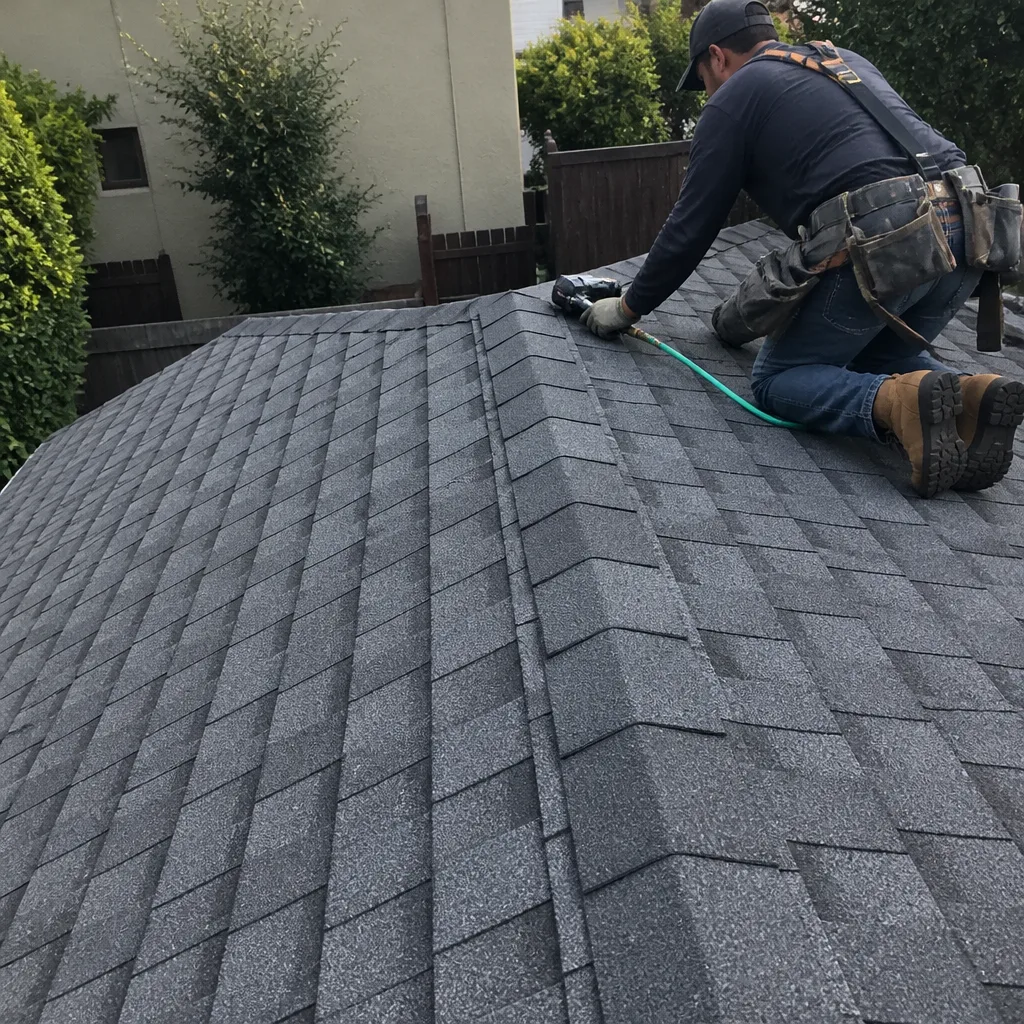 After
After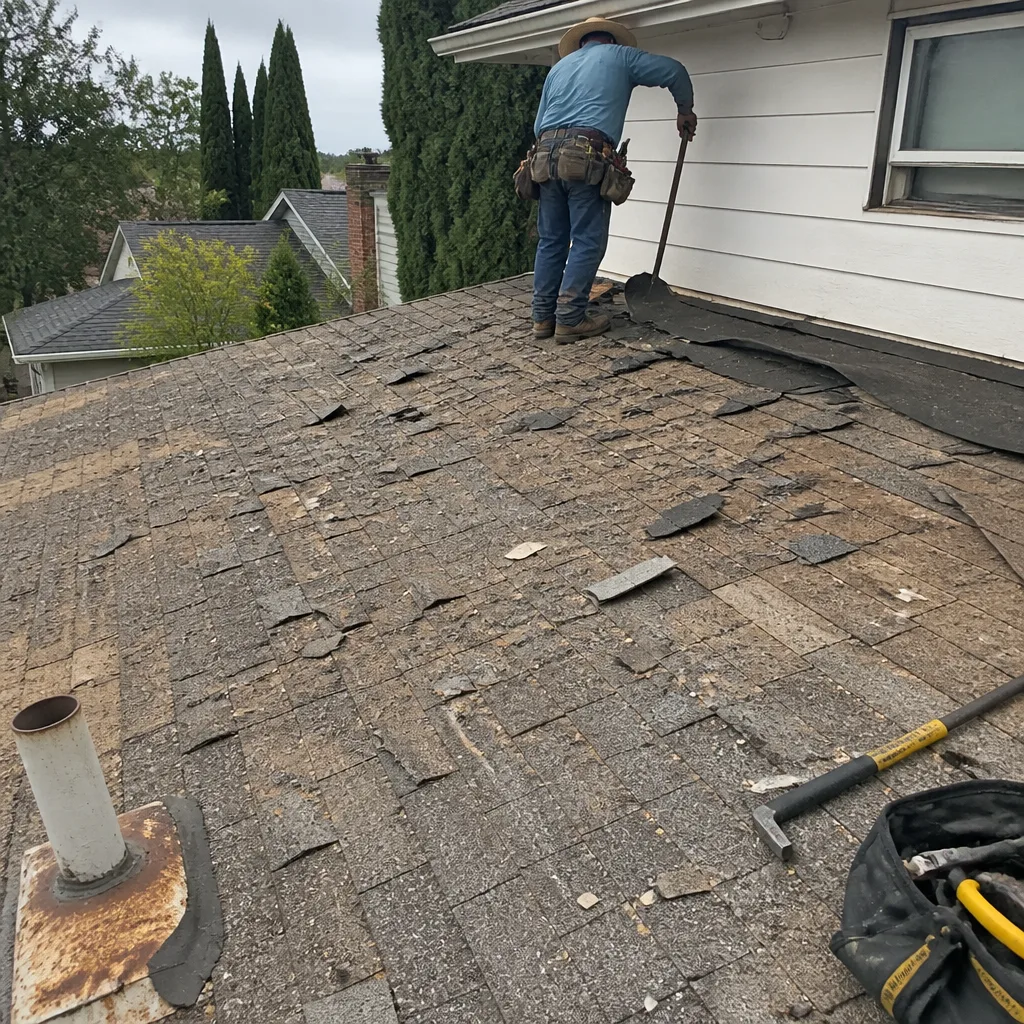 Before
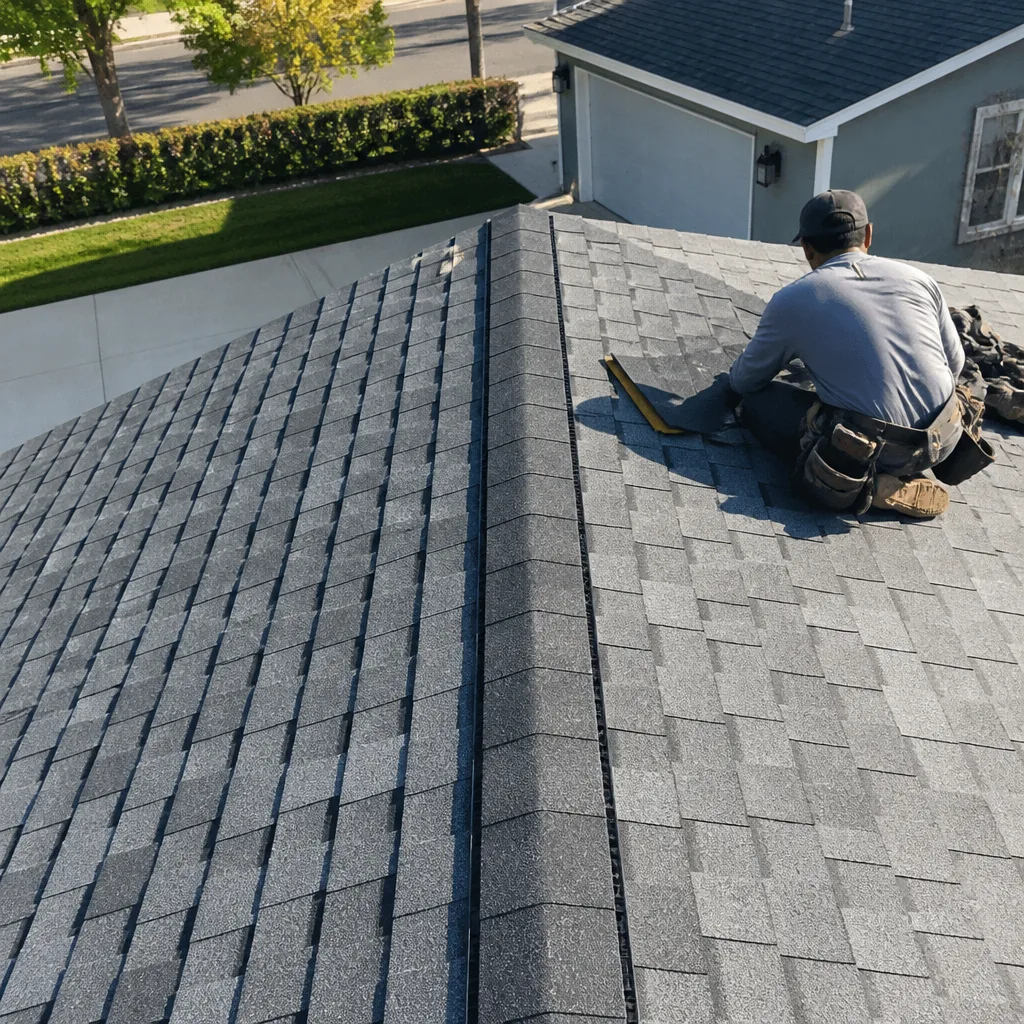 After
After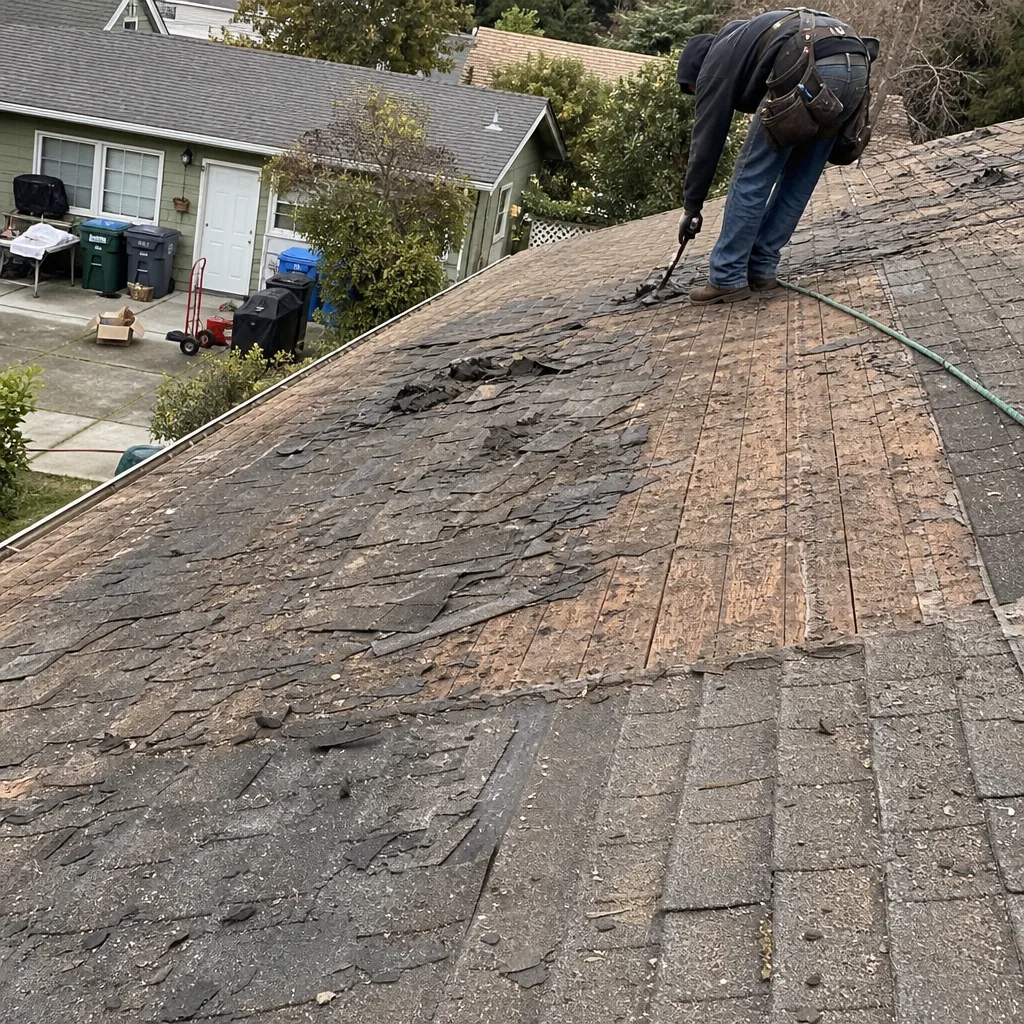 Before
 After
AfterWhen to Call a Professional
You need a professional when you see any flashing separation, granule accumulation over the half-cup threshold, or attic staining that traces a pattern. These are not DIY-observation items anymore; they require an experienced eye and a moisture meter. If your home has a roof-to-wall transition on a pre-1980 structure, or if you have a tile roof with visible mortar cracking at flashing points, schedule an inspection sooner rather than later. The inspection will either give you peace of mind or give you a repair window before the water gets in. Crestview Roofing Co Pasadena offers free estimates in Pasadena. Call (626) 389-1956 to schedule yours, or use our Roof Repair in Pasadena page to understand what inspection and repair pricing looks like.
Frequently Asked Questions
The deciding factors are the extent of granule loss, the condition of the flashing throughout the roof system, and whether the sheathing underneath has been compromised. If granule loss is widespread across multiple roof slopes and the flashing has failed in several locations, Roof Replacement in Pasadena is usually more cost-effective than repeated repairs. A repair is appropriate when the problem is localized: one flashing point, one section of damaged sheathing, or one slope showing granule loss. Call (626) 389-1956 for a free assessment.
Granule loss looks like coarse black or dark gray sand accumulating in the gutter and downspout splash block. It’s most visible at downspout outlets.
Every two years for shingle roofs over 10 years old, and every two to three years for tile roofs, with additional checks after major Santa Ana wind events. The wind events in particular loosen flashing and lift tile edges.
You can perform the observations in this guide from the ground or from inside your attic. Granule measurement, flashing observation, and attic checks are all safe DIY activities. What you should not do is walk the roof surface, especially on a tile roof, which is both fragile and slippery. If your observations indicate a problem, leave the on-roof inspection to someone with proper training and safety equipment.
Roof-to-wall transitions, especially on Spanish Colonial and Craftsman homes that were re-roofed before 1980. The counter-flashing details were commonly installed incorrectly in that era, and the failures show up as lifted metal and cracked sealant at the wall line.
Inspections are free with Crestview Roofing Co Pasadena when you’re evaluating a roof for repair or Roof Installation in Pasadena. Call (626) 389-1956 to schedule, and you’ll get a written report with photo documentation as part of The Relay Standard. For a broader look at our process, start at the Crestview Roofing Co Pasadena home page.
The Bottom Line
The warning signs that cost Pasadena homeowners the most are not dramatic. They’re cumulative. Granule accumulation in a splash block, a piece of flashing that’s lifted a quarter inch, an attic stain that follows a seam, a soffit vent that got painted shut. Each one is easy to miss and easy to ignore. Each one, ignored long enough, turns into a roof deck replacement instead of a repair. Learn to read the signs. Measure your granules. Check your attic after rain. Look at your flashing twice a year. And when something looks wrong, call (626) 389-1956 before it becomes a bigger problem than it needed to be. For more guides & resources, visit our blog.
Written by Dylan Pace, Owner at Crestview Roofing Co Pasadena, serving Pasadena since 2000.